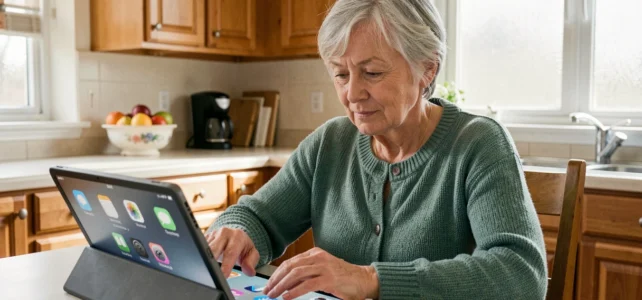
What solutions really simplify the daily lives of seniors at home, and on what criteria can they be compared? Between the recently expanded financial aids, connected health devices, and housing adaptation measures, the landscape has changed in recent years. This article reviews the most significant options for staying at home, based on available data.
Social Connection Hours in the APA: An Underrecognized Lever for Seniors’ Daily Lives
Since January 1, 2024, beneficiaries of the Personalized Autonomy Allowance (APA) at home can receive up to 9 hours per month dedicated to social connection. This change, stemming from decree n° 2023-1431 of December 30, 2023, marks a break from the previous logic, which focused solely on material assistance and care.
Specifically, these hours cover conversation visits, support for group activities, or regular phone calls. The fight against isolation thus becomes an officially funded component of the support plan. For caregivers, this evolution means that part of the relational support can be covered without drawing from the hours reserved for household tasks or personal care.
Specialized platforms like ideosenior.fr list the various aids and services available to adapt the daily lives of elderly people, including these recent measures.
Comparison of Home Care Solutions for Seniors
Not all solutions have the same cost, level of technicality, or objective. The table below summarizes the main categories.
| Type of Solution | Main Objective | Possible Funding | Required Technical Level |
|---|---|---|---|
| Housing Adaptation (grab bars, walk-in shower, toilet riser) | Safety and mobility | APA, Anah aids, pension funds | Low (installation by a professional) |
| Connected Health Devices (pill dispenser, watch, fall detector) | Medical monitoring and alerts | Some mutuals, APA depending on the support plan | Medium (initial setup, charging) |
| Social Connection Hours (APA) | Combat isolation | APA at home | None |
| Home Automation (voice assistants, automated shutters, smart lighting) | Comfort and daily autonomy | Tax credit, variable local aids | Medium to high (installation, maintenance) |
| Municipal Register of Vulnerable Persons | Security in case of crisis (heatwave, severe cold) | Free (automatic registration from July 2026) | None |
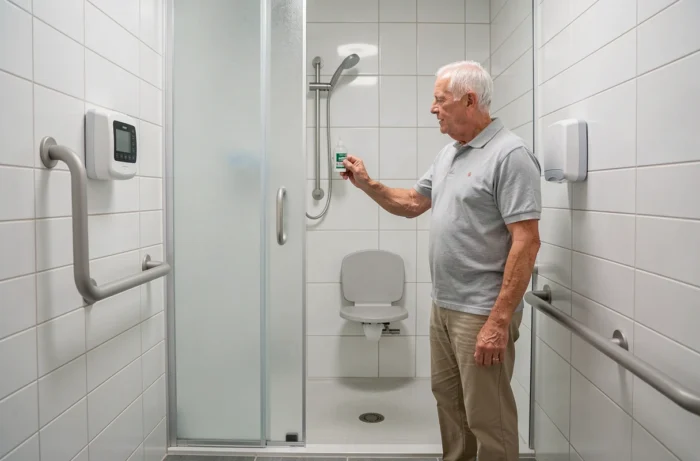
Housing adaptation remains the most technically accessible solution. In contrast, connected health devices require initial support that caregivers or a home care service often need to provide.
Municipal Register and Automatic Registration: What Changes for Seniors’ Safety
Since July 5, 2026, decree n° 2026-590 has expanded the use of the municipal register of vulnerable persons. Beneficiaries of the APA at home, PCH, and certain pension benefits in case of loss of autonomy are now automatically registered.
This register allows municipalities to directly contact vulnerable individuals during extreme weather events or health crises. Before this reform, registration relied on a voluntary process, which left a significant portion of isolated seniors unregistered.
For families, this automatic registration reduces an often-overlooked administrative burden. It does not replace tele-assistance or fall detection systems, but it adds an institutional safety net at no cost and without technical manipulation.
Connected Devices and Housing Adaptation: Deciding Based on the Senior’s Profile
Competitors often list around twenty devices without a clear hierarchy. The choice, however, depends on three concrete variables:
- Level of loss of autonomy: a person classified as GIR 4 needs occasional aids (grab bars, toilet riser), while a GIR 2 requires a more monitored environment (fall detector, connected pill dispenser with alerts)
- The presence or absence of a regular caregiver: without a caregiver, connected devices that send alerts remotely make perfect sense, as they compensate for the lack of physical monitoring
- The senior’s technological affinity: a voice assistant simplifies certain daily tasks, but its adoption requires a minimal familiarity with voice commands, which is not universal
Housing adaptation (walk-in shower, automatic lighting in hallways, removal of door thresholds) generates immediate and lasting benefits. These adjustments require no digital maintenance, unlike connected devices that require updates, recharges, and sometimes subscriptions.
Conversely, connected devices offer a remote monitoring capability that physical adjustments cannot provide. A connected pill dispenser alerts the caregiver in case of missed medication. A watch with a fall detector sends a signal to relatives or a tele-assistance center.
Funding for Home Care Aids: Overlapping Support Systems
A rarely detailed point concerns the possibility of combining multiple funding sources for the same adaptation project. The APA covers part of the human and technical aids according to the personalized support plan. Pension funds (Carsat, MSA) offer complementary aids for housing adaptation, subject to income conditions.
The Anah finances adaptation work through the MaPrimeAdapt’ program, which targets owner-occupants over 70 years old or those experiencing loss of autonomy. These aids can be combined, but the applications must be submitted in parallel, which represents a significant administrative burden for families.
- APA at home: personalized support plan including hours of assistance, equipment, and now social connection
- Pension funds: occasional aids for adaptation (variable ceilings depending on the funds)
- Anah / MaPrimeAdapt’: structural work (bathroom, accessibility)
- Mutuals: some cover part of the cost of connected health devices or tele-assistance
The CNSA also supports innovative projects in the medico-social sector. In 2026, 5 new projects were selected to experiment with home support solutions, according to the official CNSA website.
The main obstacle remains the coordination between these systems. A senior or their caregiver often has to contact multiple parties (department, pension fund, Anah, mutual) without a single point of contact. Online platforms that centralize information about these aids meet this need for clarity, but they do not replace human support for assembling the applications.