Citizen participation in Rennes is based on structured mechanisms that go beyond simple one-time voting. Participatory budget, metropolitan right of interpellation, co-design of consultations on transportation: the city and its metropolitan area have established several mechanisms allowing residents to intervene at different stages of public decision-making. These tools, active for several years, are concretely transforming urban planning and ecological transition policies.
Metropolitan right of interpellation: a little-known citizen lever
Most articles on participation in Rennes focus on the participatory budget. Another mechanism deserves special attention: the metropolitan right of interpellation. Since autumn 2024, residents, collectives, or associations can address Rennes Métropole on a subject within its competencies, subject to admissibility and support conditions.
This mechanism changes the very nature of participation. Instead of responding to a call for projects defined by the community, citizens themselves raise the questions. The initiative comes from the ground, not from the institution. This is a structural difference from the participatory budget, where the thematic framework remains set in advance.
However, interpellation requires gathering a sufficient number of supports and formulating a request that falls within the metropolitan area’s scope of competencies. Resources documenting these collective approaches are accessible on rennes-en-commun-2020.fr, which aggregates information on civic life in Rennes.
Participatory budget in Rennes: beyond voting
The participatory budget of Rennes has existed since 2015. It allocates several million euros each year to finance projects directly proposed by residents, which are then submitted to a vote. All Rennes residents can participate, without age or nationality restrictions, whether they are individual residents, associations, collectives, or schools.
The mechanism has produced tangible results. Since its launch, over 260 projects have been selected, and more than 160 have been completed. The themes cover urban planning, mobility, health, environment, and culture.
The process follows an annual cycle in three phases:
- A project submission period by residents on the La Fabrique citoyenne platform, open for several weeks
- A technical study phase by the City services, which check the feasibility of each proposal
- A voting period open to all Rennes residents to select the winning projects
The City’s stated goal is to place Rennes residents at the heart of public debate and to experiment with new forms of consultation. Communication around the mechanism aims to break away from institutional codes, with messages tailored to reduce linguistic and psychological barriers to participation.
Citizen Assembly and co-design of transportation consultations
The Citizen Assembly of Rennes Métropole operates in a different register from the participatory budget. In January 2025, its members worked on the composition and facilitation of resident panels planned for the consultation of the T3 and T4 trambus lines.
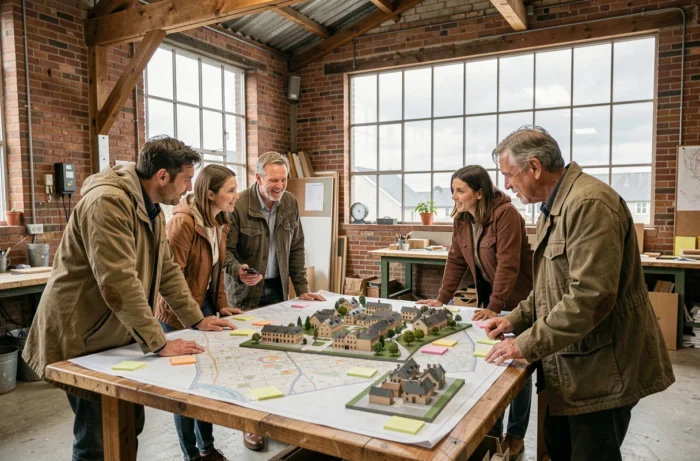
The originality of this approach lies in its positioning within the decision-making process. Citizens do not vote on a finished project: they participate in the very design of the consultation mechanism. In other words, they define how the consultation will take place, who will be invited to express themselves, and under what modalities.
This type of involvement, upstream of the decision, remains rare in French local authorities. It requires the institution to agree to share the methodological framework, not just the final result.
Citizen Spring: a metropolitan meeting around transitions
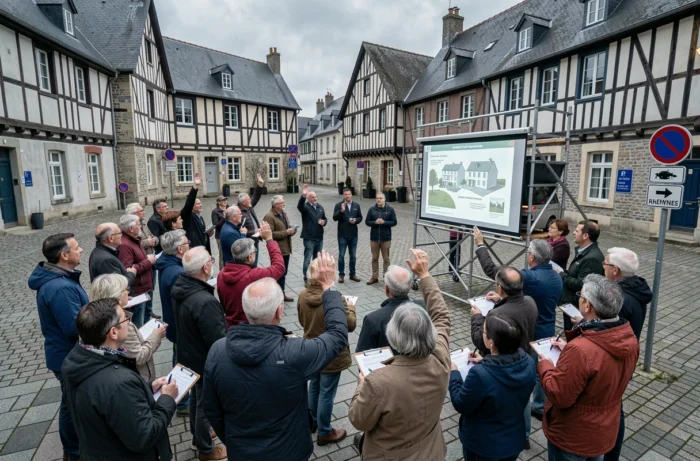
The Citizen Spring, whose fourth edition took place from April 18 to May 30, 2026, brings together over six weeks activities led by citizens, associations, and municipalities of Rennes Métropole. The central theme questions what it means to be a citizen in the face of ecological, democratic, social, and urban transitions.
This project stems from the work of the Metropolitan Convention on Citizenship, composed of 86 residents of the metropolitan area. It is co-organized by Rennes Métropole, the Citizen Assembly, the Local Energy and Climate Agency of the Rennes region, and the House of Consumption and the Environment.
Labeling criteria allow for the selection of initiatives integrated into the program. Any collective or association can propose an activity, provided it aligns with the theme of transitions and respects the framework set by the organizers.
Shared spaces and local ecological transition projects
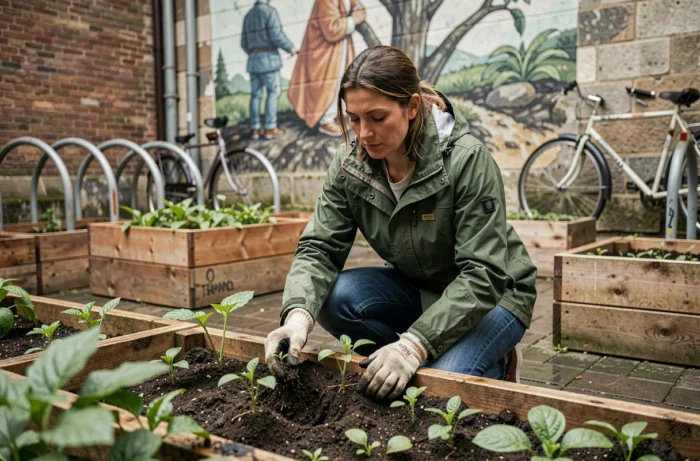
The “Our Common Spaces” initiative illustrates a form of participation that goes beyond voting and traditional consultation. Collectives can propose concrete uses for metropolitan sites made available. At La Ménardière, in Vezin-le-Coquet, two associations are carrying complementary proposals: a pedagogical trail and a photovoltaic project with collective self-consumption.
This type of participatory project anchors ecological transition in a physical location. Residents do not vote for an abstract idea: they commit to bringing a space to life, maintaining it, and developing activities there. Responsibility is shared between the community (provision of land) and project leaders (facilitation and management).
The question of nature in the city remains a subject of tension. Local associations have publicly criticized certain developments and demanded more ambitious measures for the preservation of trees and green spaces. Citizen participation does not automatically produce consensus, and these disagreements are part of the normal functioning of local democracy.
The Rennes mechanisms therefore cover a broad spectrum, from project submission to the right of interpellation, from co-design of consultations to shared management of spaces. Their common point: each assumes a long-term commitment, not just a simple one-time consultation. The robustness of these mechanisms will be measured by their ability to integrate critical voices as well as consensual projects.