Choosing a car seat for a child involves comparing levels of protection that certification alone cannot differentiate. The European standard R129 (i-Size) sets a minimum regulatory threshold, but performance gaps between certified models remain significant. This article measures these gaps based on independent test data and identifies the technical criteria that truly make a difference.
Results of Independent Crash Tests: What R129 Certification Doesn’t Reveal
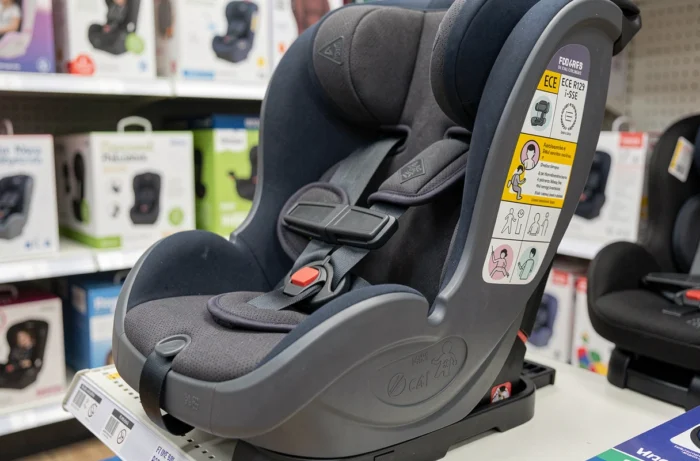
Certification guarantees that a car seat has passed a minimum safety threshold. It does not rank models against each other. The ADAC tests published in autumn 2025 illustrate this discrepancy well.
| ADAC Result (autumn 2025) | Number of Seats | Proportion |
|---|---|---|
| Good | 5 | About 29% |
| Satisfactory | 9 | About 53% |
| Insufficient | 3 | About 18% |
Of 17 seats evaluated, 3 were deemed insufficient despite their certification. The ADAC criteria exceed regulatory requirements: safety in side impacts, ease of use, ergonomics, and the presence of undesirable substances in textiles.
A seat rated “satisfactory” by ADAC provides adequate protection. In contrast, a seat rated “insufficient” may have weaknesses in one or more of these additional criteria, which the R129 certification does not test with the same rigor. Consulting Maman Anonyme’s guide on car seats allows for cross-referencing these results with other recent comparisons.
Isofix Compatibility and Electric Vehicles: An Often Overlooked Criterion
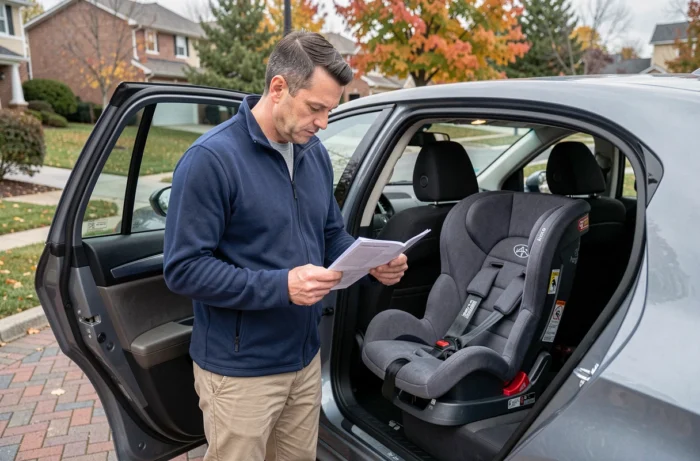
The presence of Isofix anchor points in a vehicle does not guarantee that a given seat will install correctly. Several physical parameters come into play.
- The length of the rear bench may prevent the deployment of the support leg (stabilizing leg) of certain seats, especially bulky rear-facing models.
- The angle of the rear bench backrest alters the sitting angle of the car seat. An inappropriate angle reduces protection in the event of a frontal impact.
- The shape of the floor, particularly in electric vehicles where the battery is housed under the cabin, can modify the allowed support areas for the stabilizing leg.
Electric vehicles pose a specific compatibility issue related to the elevated or rigid structure of the floor. The stabilizing leg, which stabilizes the seat downward, may not find stable support or may conflict with the floor geometry.
Before purchase, the only reliable check is to try the seat in the vehicle. The compatibility lists provided by seat manufacturers serve as a first filter, but they do not always cover recent car models.
Rear-Facing Position and Harness: Two Measurable Technical Parameters
Rear-Facing as Long as Possible
Regulation R129 mandates rear-facing until at least 15 months. Testing organizations and road safety specialists recommend extending this position well beyond, as long as the child’s size allows.
Rear-facing distributes the forces of a frontal impact across the entire surface of the back, rather than concentrating them on the neck. A young child’s head represents a much larger proportion of their body weight than in adults, making their cervical vertebrae particularly vulnerable in a collision.
Five-Point Harness or Impact Shield
The five-point harness keeps the child in close contact with the seat at the shoulders, hips, and crotch. The impact shield, on the other hand, restrains the upper body with a pad placed in front of the child.
Both systems achieve satisfactory results in crash tests. The harness offers more precise restraint and limits lateral head movement more effectively. The shield may be suitable for children who refuse the harness, but it assumes the child remains seated upright, which is not always the case during sleep.
Installation Errors and Thick Clothing: Everyday Risks
A car seat rated highly in crash tests loses some of its effectiveness if it is improperly installed or if the child is wearing inappropriate clothing.
A padded jacket creates a gap between the body and the harness that increases the child’s movement in the event of a crash. The straps, tightened over the thickness of the clothing, end up being too loose once the fabric is compressed by the force of the impact. The recommendation is simple: remove the coat and cover the child with a blanket over the tightened harness.
The installation itself remains a frequent source of error. A poorly engaged Isofix seat (the connectors must produce an audible click and a visible green indicator) or a twisted harness reduces actual protection.
- Check that the Isofix locking indicator turns green with each installation.
- Pass a finger between the harness strap and the child’s collarbone: if more than one finger fits, the harness is too loose.
- Ensure that the chest clip of the harness is at armpit level, not on the belly.
Convertible Car Seat or Age-Group Purchase: Which Choice for Safety
Convertible seats cover several growth phases with a single product. Seats dedicated to a specific size range are designed to optimize protection over a narrower range.
A seat dedicated to a size range generally offers a more precise fit than a model covering the entire growth from birth to 150 cm. The protective shell, harness position, and recline are calibrated for a more uniform build.
Conversely, a well-designed convertible seat can achieve good results in crash tests across its entire usage range. The distinguishing criterion remains the performance measured during independent testing, not the product’s marketing category.
The choice between these two approaches depends on the budget and the acceptable frequency of replacement. Two to three successive seats (infant carrier, rear-facing seat, booster with backrest) cover the period from birth to ten years. One or two convertible models can reduce this number, provided their results in independent tests are verified for each covered size phase.
The most reliable data for making a decision remains the results from independent tests like ADAC, which evaluate each seat under standardized conditions. R129 certification opens the market door, but only these tests allow for a comparison of what actually happens in a collision.