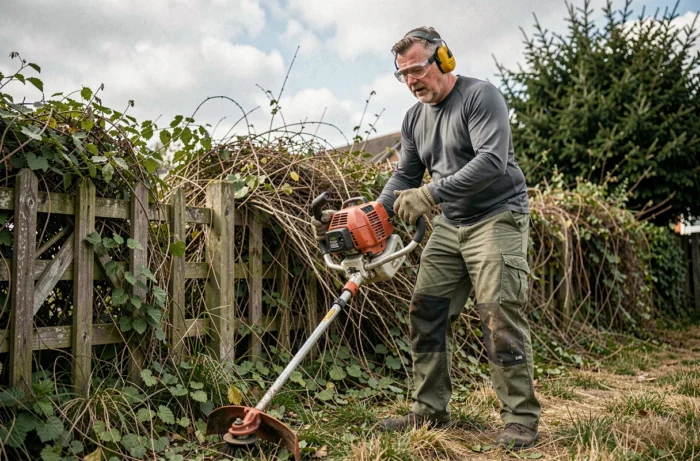
A bank overrun with brambles, a ditch lined with nettles as tall as your arm, a fence nibbled by vegetation: the mower can’t get through, the trimmer stalls after three stems. This is precisely where a brush cutter comes into play. However, one must choose the right machine and know how to use it safely, as technical parameters, regulatory constraints, and terrain conditions change everything.
Noise regulations and brush cutters: what determines the choice of engine
Before even comparing engine displacements or voltages, one must check a point that most guides overlook: the permitted hours in their municipality. There is no single national time slot for using a brush cutter. The hours are set by municipal or prefectural decree and vary significantly from one municipality to another.
In Puteaux, gardening work by individuals is prohibited on Sundays and public holidays. In Saint-Pourçain-sur-Sioule, certain tasks are allowed on Sundays from 10 a.m. to 12 p.m. Two municipalities, two rules. Not checking can risk a fine for noise disturbances.
This local constraint directly influences the type of engine. In city centers, near schools, or in areas subject to strict time restrictions, a battery-powered brush cutter offers a reduced noise level and no local emissions. One can work in shorter time slots without disturbing the neighbors. To compare available models and their features, detailed sheets can be found on ma-debroussailleuse.com that facilitate this decision-making.
The thermal engine, on the other hand, retains its place as soon as one leaves the urban context: long brush clearing, dense vegetation, terrain far from any power outlet. The question is not “battery or thermal” in absolute terms, but which engine for which intervention site.

Adapting the cutting system to the type of vegetation
Generic advice often suggests “line for grass, blade for brambles.” The reality on the ground is more nuanced.
Nylon line: not just for finishing touches
Nylon line (round or square) is suitable for soft grass, weeds, and edges. A square section line grips medium stems better than a round line. It is also used to clean around the bases of fruit trees without risking damage to the bark with a metal blade.
Its limit: as soon as the stems exceed the diameter of a pencil, the line breaks or wears out too quickly. One then moves on to something else.
Grass blade, bramble blade, circular saw
For brambles, thick ferns, and hazel shoots, a three or four-tooth blade is sufficient in most cases. The circular saw (multi-tooth blade like a wood saw) is only relevant for young tree trunks or woody brush several centimeters in diameter.
Mounting a circular saw on a low-powered machine is counterproductive: the engine struggles, the cut is uneven, and the operator tires more quickly. The blade should be adapted to the available power, not the other way around.
- Soft grass and edges: round or square nylon line, suitable for finishing and working near obstacles
- Brambles, ferns, semi-woody stems: three or four-tooth blade, a good compromise between efficiency and safety
- Tree shoots and thick woody brush: circular saw, reserved for sufficiently powerful machines
Weight, harness, and fatigue: the criteria often underestimated in gardening
On paper, the engine power grabs attention. In practice, the total weight and the quality of the harness determine the actual working duration. A heavy machine poorly harnessed causes back and neck pain after about twenty minutes.
A simple shoulder harness is sufficient for short sessions on flat terrain. As soon as one works on a slope, on a bank, or for more than half an hour, a double harness (like a belt) distributes the load across both shoulders and the hips. Feedback varies on this point depending on individual morphology, but the difference in comfort is clear for most users.
The type of handle also matters. A bicycle-type handlebar provides good lateral control for mowing large flat areas. A D-shaped or loop handle offers more freedom to work at angles, under fences, or in corners.

Protective equipment for safe brush clearing
Flying stones, wood splinters, and fragments of nylon line pose the main risk. A stone propelled by a brush cutter head reaches a speed sufficient to cause serious injuries to the face or legs.
For regular use, one should not settle for just goggles and gloves. Risk assessment leads to wearing a coherent set:
- Eye and face protection: full visor or wrap-around glasses, the visor also protects the lower face
- Hearing protection: earplugs or noise-canceling headphones, especially with a thermal engine whose noise level is high
- Reinforced pants: the legs receive the majority of projections, regular jeans are not sufficient
- High-top shoes or safety boots: stability on rough terrain and protection against falling objects
Wear all equipment from the first minute of work, not just when the terrain seems difficult. Most accidents occur during routine sessions, due to overconfidence.
Regular maintenance of a brush cutter: what extends its lifespan
A machine cleaned after each use lasts significantly longer than one stored as is. Plant residues stuck around the cutting head retain moisture and accelerate corrosion.
After each session
Remove debris around the protective cover and cutting head. Check the condition of the line or blade. A line that is too short reduces efficiency and strains the engine.
At the beginning and end of the season
On a thermal model, the air filter and spark plug condition the starting. A clogged filter increases consumption and reduces power. On a battery model, store the battery at room temperature, partially charged, to preserve its capacity in the long term.
Choosing a brush cutter suited to one’s terrain and local constraints is already half the job done. The other half lies in consistency: maintaining the machine, wearing protective gear, and respecting the time slots of one’s municipality. A well-chosen and well-used tool transforms a gardening chore into a quick and controlled intervention.