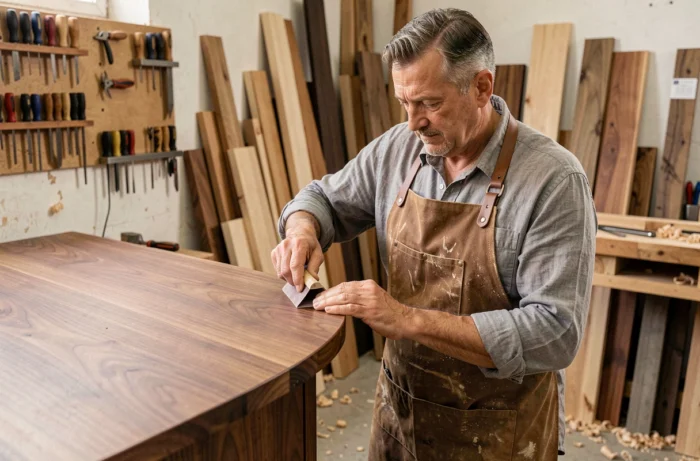
Custom furniture for modern living spaces stands out from standard furniture based on measurable criteria: dimensional adaptation, material choices, durability, and now environmental compliance. Comparing these two approaches helps to identify where custom solutions provide a real performance gap and where they represent an additional cost without significant functional gain.
Custom Furniture vs. Standard Furniture: Compared Technical Criteria
| Criterion | Standard Furniture | Custom Furniture |
|---|---|---|
| Adaptation to space dimensions | Fixed dimensions, frequent discrepancies with atypical configurations (sloped ceilings, alcoves, non-right angles) | Precise measurements, manufacturing adjusted to the millimeter |
| Material choices | Limited range (melamine, particle boards) | Wide range: solid wood (oak, walnut, cherry), veneer, metal, lacquered MDF |
| VOC and formaldehyde emissions | Variable by manufacturer, labeling sometimes absent | Possible source control, selection of low-emission panels |
| Repairability | Spare parts rarely available after a few years | Components reproducible by the original workshop |
| Delivery time | Immediate to a few days | Several weeks to a few months depending on complexity |
The most significant gap lies in dimensional adaptation. An integrated wardrobe under a sloped ceiling, a storage unit following a curved wall, a desk built into a niche: these configurations render standard furniture unusable or create wasted space. Custom solutions are fully justified only when the geometry of the room requires specific manufacturing.
Several workshops specializing in interior design now offer comprehensive support, from design to installation. This is the case for the professionals listed on dofacto-design.com, who work on design furniture projects tailored to the constraints of each space.
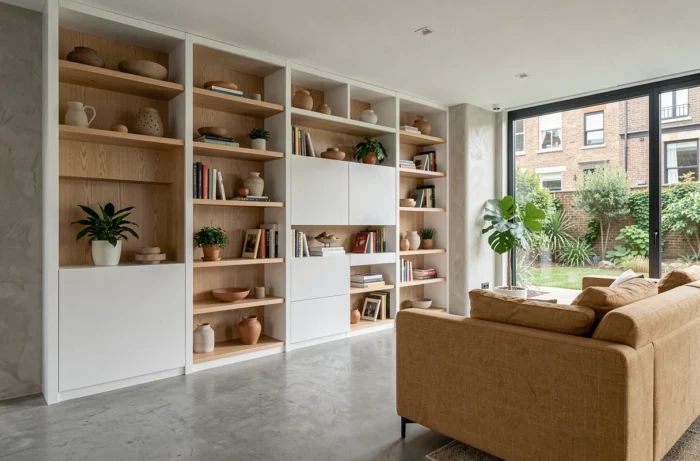
Formaldehyde and VOCs in Furniture: A Regulatory Constraint to Incorporate into the Project
The choice of materials in a custom furniture project is not just about aesthetics. Reconstituted wood panels (particle board, MDF) used in furniture manufacturing emit formaldehyde and volatile organic compounds. These substances affect indoor air quality, a critical parameter in enclosed living spaces.
In France, VOC emission labeling has existed since 2012 for construction and furniture products. However, its concrete application in the furniture sector remains partial, due to a lack of text specifying all the modalities.
At the European level, the REACH framework tightens the limits on formaldehyde emissions for furniture and adhesives. For a custom interior design project, this means that the choice of panel and glue directly conditions the air quality of the dwelling.
Materials to Favor to Limit Emissions
- Solid wood (oak, beech, walnut) naturally emits very little VOC, making it the safest material for a bedroom wardrobe or a living room piece
- E1 rated MDF or melamine panels (low formaldehyde emissions) are an acceptable compromise for storage or a desk, provided certification is verified
- Oil or natural wax finishes reduce emissions compared to polyurethane varnishes, often used in industrial manufacturing
A custom furniture workshop that masters its supply chain can document the origin and classification of each material. In contrast, standard imported furniture rarely offers this level of traceability.
Public Contracts and Custom Furniture: The Deadline of August 21, 2026
Article 35 of the Climate and Resilience Law (law no. 2021-1104 of August 22, 2021) and its implementing decree no. 2022-767 modify the rules for awarding French public contracts. From August 21, 2026, all public contracts must include at least one environmental award criterion and an environmental execution clause. Awarding contracts solely based on price becomes illegal.
For custom furniture manufacturing workshops, this deadline creates a measurable competitive advantage. Orders for public spaces (town halls, schools, administrative offices) will require precise documentation on the durability, repairability, and carbon footprint of the delivered furniture.
What This Changes for a Design Project
Craftsmen capable of providing a material assessment, a technical sheet of emissions, and a repairability guarantee will have privileged access to these markets. Material traceability becomes a selection criterion, not just a commercial argument.
This mechanism does not directly concern individuals, but it raises the entire sector’s standards. A carpenter who structures their production to meet public market requirements applies the same quality standards to private orders: wardrobes, bookshelves, storage units, or built-in desks.

When Custom Furniture Is Not Justified
A storage unit intended for a room with standard dimensions, with straight walls and a typical ceiling height, gains no functional benefit from custom manufacturing. The aesthetic gain exists, but the additional cost is then measured only in design customization, not in space optimization.
The manufacturing time constitutes another parameter. A custom furniture project involves several weeks between taking measurements and installation. For an immediate need (moving in, quick renovation), standard range furniture remains more suitable.
- Room with standard dimensions and straight walls: custom solutions do not provide significant space gains
- Tight budget without architectural constraints: a standard solid wood piece offers comparable material quality at a lower cost
- Temporary need (short-term rental, transitional arrangement): modular and movable furniture is more relevant
Custom furniture delivers its full value when it solves a problem that standard options cannot address: atypical geometry, technical integration (lighting, wiring, ventilation), or documented requirements regarding pollutant emissions. Outside of these cases, the difference is a matter of aesthetic choice, not functional necessity.