
A move that drags on, an apartment that’s too small, a stock of goods to store for a few weeks: renting a storage unit addresses very concrete situations. The self-storage market in France has matured in recent years, with an average occupancy rate of centers reaching 80.2% according to the FEDESSA/CBRE 2025 report. Finding the right space at the right price therefore requires a minimum of method.
Professionals in storage units: a use that guides overlook
Storage units are often associated with individuals who lack space at home. This image is incomplete. French self-storage has become a link in urban logistics, with a growing share of professional clients.
Craftsmen, micro-enterprises, and e-commerce merchants rent storage units as mini-proximity warehouses. A carpenter stores his wood scraps and seasonal tools there. An online seller prepares his shipments without paying for a commercial lease.
Professionals represent a rapidly growing segment in self-storage centers. This point has a direct consequence on availability: the most requested units (between 5 and 15 m²) become available less quickly than before. If you are looking for a storage unit rental in Noisy le Grand with ImmoVite, it’s better to plan a few weeks in advance rather than booking at the last minute.
Price of a storage unit: what really affects the bill
The average rent for self-storage in France is measured at 294 euros per square meter per year (FEDESSA/CBRE 2025 data). But this overall figure masks considerable disparities.
Why can two storage units of the same size cost double one another? Three factors weigh more than others:
- The location of the center: a unit in a dense area (intra-muros Paris, central Lyon) costs significantly more than in the suburbs or rural areas. The price of land directly affects the monthly rent.
- The actual rented size: the price per square meter decreases as the area increases. A 2 m² unit is proportionally more expensive than a 20 m² space.
- The duration of commitment: some operators offer a decreasing rate beyond three or six months of rental. Others charge monthly, without discounts, but also without commitment.
With the market being tight (reminder: over 80% average occupancy), permanent heavy discounts are rare. Promotions for the first month at a reduced price exist, but they do not reflect the actual cost over time.
Choosing the right size of storage unit without overpaying
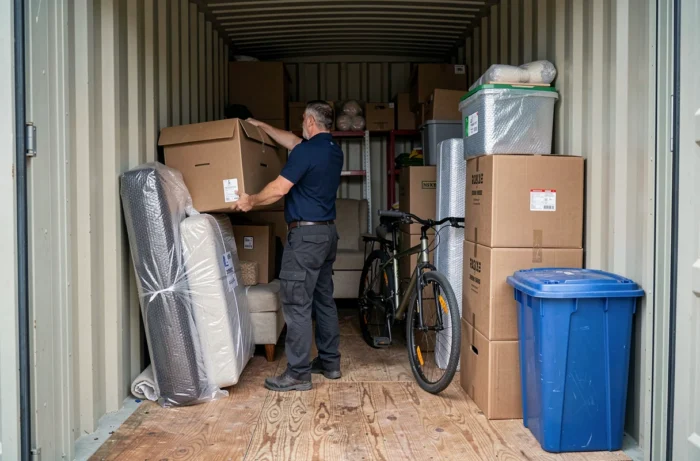
Have you ever noticed that people always underestimate the volume of their belongings? A three-seater sofa, a disassembled wardrobe, and ten boxes quickly fill a 5 m² unit. Opting for a space that is too small forces you to rent a second unit, which doubles the bill.
The most reliable method is to list each piece of furniture with its dimensions, then mentally stack the boxes. Dismantling furniture reduces the necessary volume by about a third. A disassembled king-size bed fits against a wall; when assembled, it takes up half of a small unit.
Here’s a simple guideline:
- A studio (including furniture and boxes) generally fits in a 4 to 6 m² unit.
- A furnished two-room apartment requires rather 6 to 10 m².
- Beyond that, for a three-room apartment or the stock of a craftsman, you should count at least 10 to 15 m².
Choosing a unit slightly larger than estimated allows for movement inside and access to items at the back without having to take everything out. This ease of access saves time on each visit.
Security and insurance: two points to check before signing
A storage unit is not a safe. Security varies greatly from one center to another. Some have video surveillance, individual alarms per unit, and access via a personal code. Others are limited to a padlock and a fence.
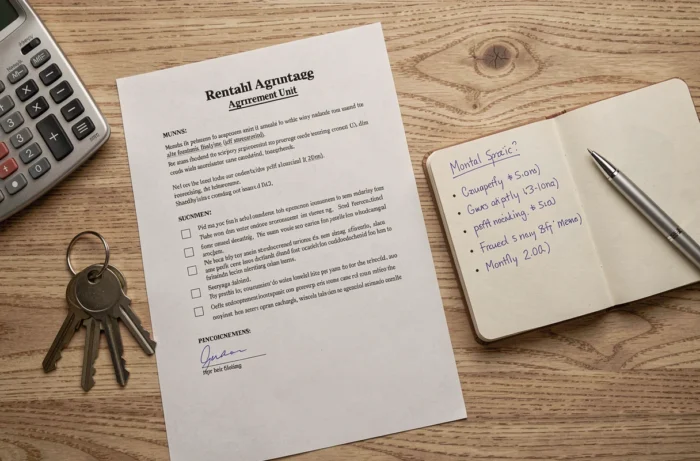
Check if the center requires insurance or if your home insurance already covers the contents of an external unit. Many tenants discover after an incident that their home insurance excludes items stored outside the home. Reading the general terms of the rental contract, paragraph by paragraph, avoids this type of surprise.
Some operators include insurance in the monthly rent. Others charge it as an extra. Comparing the “all-inclusive” rate remains the clearest way to measure the actual cost.
Prohibited items and rules to know in a storage unit
A self-storage unit does not accept just anything. Flammable, explosive, or corrosive products are prohibited in almost all centers. This is also true for perishable goods, animals (alive or dead), and illegal merchandise.
Storing hazardous materials in a unit exposes you to immediate contract termination and legal action. An order from July 27, 2026, modified the rules regarding fire protection for residential buildings concerning the use of certain spaces for storage, which strengthens the obligations of operators.
Before dropping off your belongings, take a few minutes to read the list of prohibited items displayed in the center or attached to the contract. Ignoring this list can be costly in case of an inspection or incident.
Renting a storage unit remains a flexible solution, provided that you calibrate the space, compare rates based on the actual duration of use, and check the insurance coverage. The French market being well-stocked, the best locations go quickly, especially in dense urban areas.