
The images associated with the name Anna Dray saturate news feeds without always knowing who produced them, in what context, or why they generate so many reposts. Here, we offer a technical reading of this phenomenon, relying on documented stylistic mutations and the diffusion mechanics specific to social networks.
Narrative Urban Shooting: The Visual Grammar Behind Anna Dray’s Photos
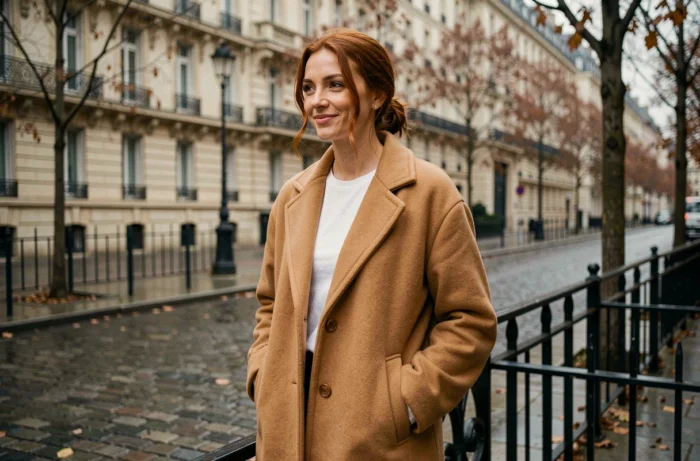
The trend identified as narrative urban shooting serves as the most effective key to understanding the virality of these snapshots. The principle relies on a gaze journey organized by composition: the viewer does not immediately fixate on the face but sweeps across the image through urban guiding lines (street perspectives, architectural shadow play, reflections on shop windows).
This treatment distances Anna Dray’s photos from the classic centered portrait. The human subject becomes as much a part of the decor as a focal point. The result produces a visual ambiguity that holds attention longer than a frontal portrait, and this prolonged observation time mechanically fosters engagement on platforms.
We observe that the most shared snapshots of Anna Dray all share this structure: a readable urban environment, a coherent color palette (desaturated tones, mineral dominance), and a framing that leaves negative space around the subject. This visual vocabulary is not a matter of chance but a precise aesthetic choice.
Dissociation Between the Person Anna Dray and the Aesthetic ‘Anna Dray Style’
A documented phenomenon complicates any frontal analysis: the name Anna Dray now functions as a moodboard reference. Photographers and visual creators with no direct link to the real person produce images described as ‘Anna Dray style,’ adopting the framing, color, and urban ambiance codes.
This appropriation of the name as an aesthetic label creates a blur between document and creation. A photo shared under the tag ‘Anna Dray’ can be both an authentic portrait and a third-party production that borrows the style. For the untrained reader, the distinction is invisible.
Consequences for the Analysis of Viral Images
This mechanism has several concrete implications:
- The volume of images associated with the name Anna Dray is artificially inflated by third-party productions that have no connection to the photographed person.
- EXIF metadata is systematically removed during uploads to social networks, making authenticity verification nearly impossible without access to the original source.
- The virality of a snapshot neither validates its authenticity nor its production context: it only reflects the alignment between visual composition and recommendation algorithms.
We therefore recommend treating each image circulating under this name as an autonomous visual object, inherently disconnected from any biographical or documentary value.
Textual Context and Meaning Distortion of Anna Dray’s Photos
The same snapshot radically changes meaning depending on the accompanying text. A photo of Anna Dray published in a journalistic context (article about the Dray family, coverage of an event) carries informative value. The same image, cropped and inserted into an Instagram carousel titled ‘Parisian Style,’ becomes aspirational content unrelated to its original intent.
The textual context determines the reading more than the image itself. Social platforms encourage the decoupling of image and caption: any user can re-associate a visual with a different narrative. This mechanism explains why some photos of Anna Dray circulate simultaneously in contradictory registers (celebrity, fashion, news).

The Removal of Metadata as an Accelerator of Distortion
On Instagram, Facebook, or X, uploading eliminates EXIF data: device used, focal length, date, geolocation. Only the raw image file remains. Without metadata, no technical verification is possible from the image alone.
This loss of information transforms each snapshot into reusable raw material. The original photographer loses all traceability. For an analyst or journalist, tracing back to the source requires a reverse image search, the results of which remain partial on massively cropped or filtered photos.
Technical Criteria for Evaluating a Snapshot Attributed to Anna Dray
Before commenting on or sharing a photo, we recommend checking several points that help distinguish a reliable document from a recycled visual.
- The source of the first publication: does the snapshot come from a verified account, an identified media outlet, or an anonymous aggregator?
- The coherence of the framing with the announced context: an editorial portrait does not have the same construction as a candid shot or a story screenshot.
- The presence or absence of photographer credit: a snapshot without credit is an unsourced snapshot, regardless of its aesthetic.
- The cropping ratio: an image heavily cropped compared to standard proportions (4:5, 16:9) often signals a secondary extraction.
These checks do not guarantee authenticity, but they help eliminate the most distant reworks from the original document.
The massive circulation of photos associated with Anna Dray illustrates a broader phenomenon: on social networks, aesthetics take precedence over provenance, and the name becomes a visual brand independent of the person. Any serious analysis of these snapshots begins by accepting this technical reality before seeking what they ‘tell.’